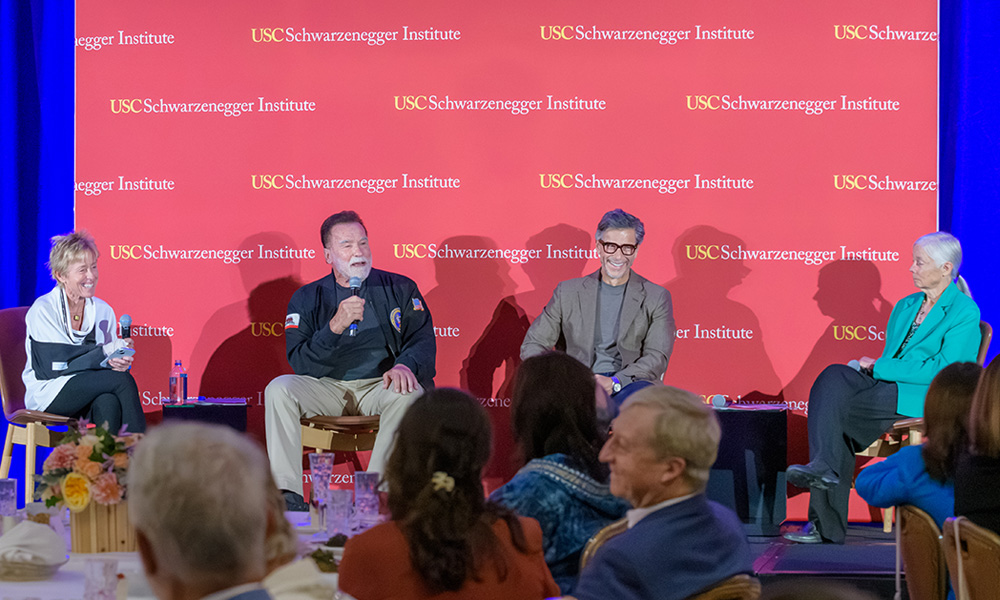
Led by former Gov. Arnold Schwarzenegger, a who’s who of elected officials and political staff members gathered in a Santa Monica hotel ballroom recently to celebrate the 20th anniversary of Assembly Bill 32, one the world’s most ambitious laws to curb climate change.
Hosted by the USC Schwarzenegger Institute and the Climate Action Reserve, the event gave attendees a master class in effective governance.
Passing a bill as complex, wide reaching, and contentious as AB32 relied on a rare combination of bipartisanship informed by evidence-based research, compromise, and the dogged determination of Schwarzenegger and his allies in Sacramento.
(For more information about how the bill was passed, please see a special report prepared by Next 10.)
The road to AB32 began years before, several attendees noted, when then-Gov. Ronald Reagan signed into law the California Air Resources Board to protect the public from air pollution. Subsequent governors from both parties, including Gray Davis, who attended the event, followed through with their own support for environmental protection, as have their successors.
Building a broad coalition to support AB32 was also key. As a Republican, Schwarzenegger said he was able to bring the business community on board while others in his administration and the legislature reached out to environmental groups and other interests.
Schwarzenegger applied the same bipartisanship to his own cabinet. His chief of staff, Susan Kennedy, for example, had held the same position with Governor Davis.
“The Republicans,” Schwarzenegger recalled, “came to me right away and said, ‘You cannot hire Susan Kennedy.’ And I said, (two-word expletive that begins with “f” and ends with “u”). “I said, ‘You’re not in charge of my hiring. I’m in charge of my hiring, and she’s hired.’”
The tent also helped.
While serving as California’s governor from 2003 to 2011, Schwarzenegger often held meetings in a tent next to the Capitol Building so he could smoke his beloved cigars — and twist arms.
One of his most important tent guests was Democrat Fabian Núñez, co-author of AB32 and the speaker of the California Assembly at the time. (Núñez, Susan Kennedy and the bill’s other co-author, former state Senator Fran Pavley, all joined Schwarzenegger on the event stage.)
Schwarzenegger said Núñez became a cigar smoker and he became a tequila drinker as a result of their meetings. But something more than bad habits began to take shape amid the fog of cigar smoke.
“All those changes (that resulted in AB32) started happening right there in the smoking tent. And we started getting along,” Schwarzenegger said. “Of course, we had our debates and our discussions and our disagreements, all of this stuff. It’s normal, but it doesn’t mean that we have to hate each other and attack each other personally.”
Schwarzenegger also singled out Pavley, also a Democrat, for praise.
“Without your writing and without your genius mind, we wouldn’t have anything, because it’s all about the bill,” Schwarzenegger said. “And then when you and Fabian got together and started perfecting the bill, it was unbelievable.”
Pavley, who now serves as environmental policy director at the Schwarzenegger Institute, returned the compliment, noting that AB32 would never have been enacted without the governor’s vision and willingness to buck conventional wisdom, not only from his own party but politics in general by enacting AB32 during an election year.
Schwarzenegger acknowledged that climate pollution was not on his to-do list when he ran for governor. But he was persuaded to take a closer look at the issue by U.S. Rep. Joseph Kennedy II.
“You’re not going to win if you don’t have a real clear vision about the environment,” Schwarzenegger recalled Kennedy saying.
So Schwarzenegger did something that seems almost quaint in today’s highly partisan and ideologically driven politics: He dove into the issue – talking to experts, reading the science – and came to realize that climate change was a serious threat that demanded his attention and bold, decisive action.
The bill was so audacious, so ahead of its time, Susan Kennedy said she is still amazed that it passed.
“There were a thousand single points of failure from the internal debates during the planning and the drafting, the legislative process, the regulatory process and the political process in the middle of a heated election year,” she said. “By any view, any rational view of history, this should have failed.”
Detractors raised the usual alarm bells that the bill would be bad for the economy, bad for business, bad for jobs. Just bad.

But as Lauren Sanchez, the event’s keynote speaker and chair of the Air Resources Board noted, California’s carbon dioxide emissions have fallen 28% from their peak in 2004 while the state’s economy is now the world’s fourth largest. Among a laundry list of other benefits she noted, more than 500,000 Californians are now employed in clean energy – nearly double the number in the second-ranked state, Texas.
And the influence of AB32 did not end at California’s borders.
“We built a framework here,” Sanchez said “that spread to other states, to other nations, that catalyzed action and sparked innovation beyond our wildest dreams.”