As Los Angeles neared the end of the 20th century, the city was in crisis.
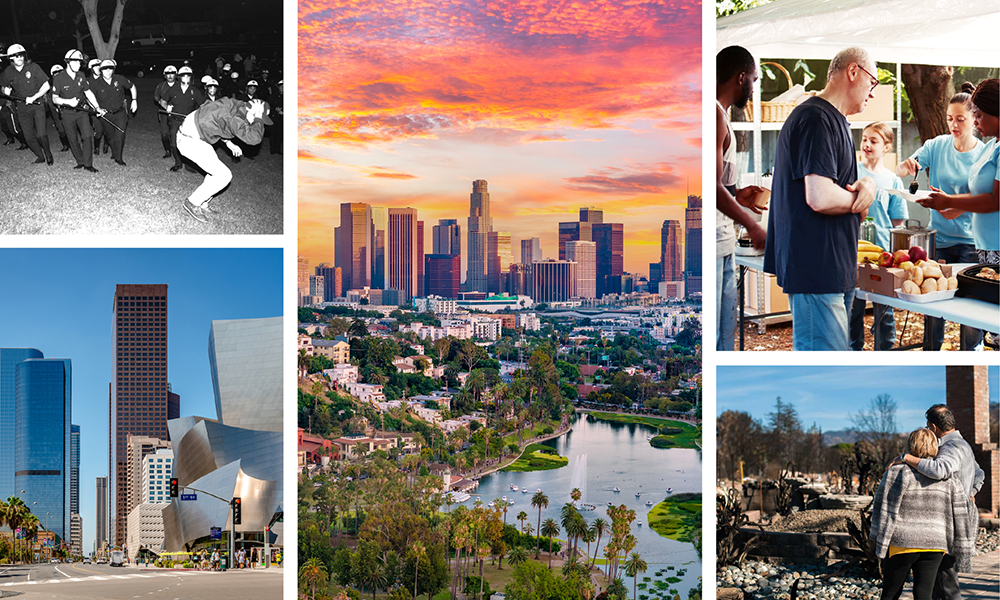
The acquittal of four police officers who were caught on video severely beating Rodney King, a Black motorist, sparked week-long riots that ultimately killed more than 50 people and caused more than $1 billion in property damage. The 1992 civil unrest exposed deep social and economic divisions in L.A., a city with extraordinary private wealth yet no shortage of social challenges.
But the crisis was also a catalyst for the city’s growing philanthropic community to come together. In the aftermath of the unrest, 29 private and corporate foundations united to create Los Angeles Urban Funders, which worked to improve conditions that contributed to the crisis.
As the city entered a new century, L.A. Urban Funders disbursed $25 million in grants over the next decade to three of the city’s poorest neighborhoods.
The L.A. philanthropy community mobilizing – and innovating – in times of crisis is a recurring theme in a new report from the Center on Philanthropy & Public Policy, a research center within the USC Price School of Public Policy.
The report – A Generation of Los Angeles Philanthropy: 25 for 25 – chronicles how L.A. philanthropy developed into a more coordinated and ambitious and impactful civic force—one increasingly willing to collaborate across institutions, work with government, reshape public spaces and listen to the communities it seeks to serve.
The Center on Philanthropy & Public Policy, which recently marked its 25th anniversary, has played a central role in that collaboration, said Cinny Kennard, the center’s Board Chair and President of the Wallis Annenberg Legacy Foundation.
“It has enabled us as philanthropic colleagues to connect, to work together, to collaborate, and ultimately engage with a community when it’s in its time of greatest need,” Kennard said. “And if it weren’t for that center, these kinds of impactful projects that are reflected in this report would never have been made possible because they were relationships that were largely built through the Center on Philanthropy and Public Policy.”

“This narrative underscores the progression of philanthropy in Los Angeles over a generation and challenges the next generation of donors and philanthropic institutions alike to learn from and build upon it, as philanthropy charts what comes next,” said Jim Ferris, Director of the Center on Philanthropy and Public Policy, who recently spoke at the Smithsonian’s National Museum of American History for an event about philanthropy’s 250-year history in America.
The report tells this story through the narratives of 25 organizations or initiatives that reflect the sector’s evolution between 2000 and 2025. L.A. Urban Funders (LAUF), for example, demonstrated that foundations could accomplish more by working together than by acting independently. It pooled philanthropic capital, aligned grants from participating foundations and supported neighborhood priorities over an extended period.

“LAUF illustrated the potential for philanthropic leaders to undertake and sustain a collective response to a major societal crisis,” said Elwood Hopkins, LAUF’s Executive Director and now Managing Director of Emerging Markets Inc. “It sparked a spirit of leadership among these leaders, a sense that — despite their intrinsically independent nature — foundations could nonetheless self-organize intelligently.”
Crises Spur Collaboration
L.A. would face more crises over the coming decades, from the fallout of the 2008 financial crisis to the 2020 COVID-19 pandemic and the 2025 wildfires. Each time, the philanthropic community came together to aid L.A.
“Almost every major collaboration grew out of a shock,” Kennard noted.
That includes the Los Angeles County Food Equity Roundtable, which Kennard chairs. Food insecurity in Los Angeles County rose to record levels during the pandemic. In response, county and philanthropic partners launched the roundtable, which ultimately convinced the county to create the Office of Food Systems to tackle food insecurity. The new office became crucial during the city’s most recent crisis: the 2025 wildfires.

“The office has had an extraordinary impact coordinating emergency response when reduced federal funding for food security and the deadly wildfires that tore through the L.A. challenged access to food,” Kennard said. “It’s hard to imagine L.A. County now without this office and central coordination.”
Collaborations like this brought philanthropy into a closer relationship with the government, the report notes. Rather than attempting only to influence public policy from the outside, foundations began working directly with elected officials and agencies, pairing philanthropic seed money and flexibility with government authority and scale.
That partnership made programs like Summer Night Lights – which provided safe public spaces and family activities for communities historically affected by crime – a success, according to the report. Another project showed the public-private approach could not only be applied to a program, but an entire place.
The revitalization of Grand Avenue required city and county officials, philanthropists, cultural institutions and private developers to work across jurisdictional and institutional boundaries. Philanthropist Eli Broad created the Grand Avenue Committee in 2000, as Walt Disney Concert Hall was under construction, to help develop a larger vision for the downtown corridor.
The effort ultimately helped produce Gloria Molina Grand Park, The Broad Museum and The Grand, a mixed-use development that includes residential towers and a hotel. In 2025, the Los Angeles County Board of Supervisors officially recognized the Grand Avenue Cultural District, intended to increase participation in the arts while supporting tourism and employment. The revitalization of Grand Avenue is expected to generate more than 10,000 jobs and $465 million in economic activity over the next quarter-century.
“Grand Avenue reflects what civic leadership and partnership can make possible when vision and persistence come together,” Gerun Riley, President of The Eli and Edythe Broad Foundation, said in the report.
A Focus on Community Engagement
New initiatives place greater emphasis on listening to residents and allowing community experience to shape priorities, the report said. That approach is evident in the Department of Angels, another collaboration born from crisis.
The organization was established following the devastating Eaton and Palisades fires of January 2025. Co-founded by California Community Foundation President and CEO Miguel Santana and Snap Inc. co-founder and CEO Evan Spiegel, the Department of Angels was designed to help affected communities lead their own recovery rather than simply receive assistance devised elsewhere.

One way that the Department of Angels aims to do this is through its quarterly survey of thousands of survivors – the only consistent and statistically significant assessment of recovery needs from the 2025 fires. The organization recently launched a philanthropic initiative to provide grants, technical support and capacity building to community organizations, with the goal of reaching more survivors.
“People living through disaster recovery understand its realities in ways that no one else can,” said Brandon Levin, Vice President in the Office of the CEO at Snap Inc., and Founding Member of the Department of Angels. “They know where systems are working, where they’re breaking down, and what resources are missing.”
Its origins echo those of Los Angeles Urban Funders more than three decades earlier: A disaster exposed the limitations of existing systems and prompted philanthropic leaders to work together. But the newer initiative also reflects how the sector has changed. Coordination remains essential, but so does giving affected residents a direct role in defining the response.
“When communities have a central role in shaping recovery, they can build more durable solutions to today’s challenges while also strengthening the capacity to navigate what comes next,” Levin said. “Our hope has been to serve this ecosystem by moving quickly, listening deeply, and keeping community at the center.”