Long before David Sloane studied lively, bustling cities, he worked at a place where people are put to rest.
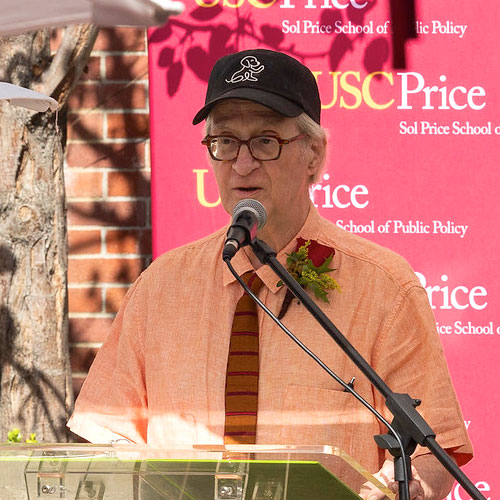
Starting at age 13, Sloane spent 14 summers working at Oakwood Cemetery in Syracuse, New York, where his father was superintendent. He clipped bushes, filled sunken graves and eventually oversaw small funerals. Those formative years inspired his first book, The Last Great Necessity: Cemeteries in American History, and set him on an academic journey that would span nearly four decades.
“He never stopped using history to tell the story of urban planning’s failures and successes, nor did he stop studying cemeteries, mourning, and death,” Sloane said, telling his career story in the third person. “That topic remained central to his scholarship from his first paper in a seminar class in 1978 through his 2018 book – Is The Cemetery Dead? – and on to today.”
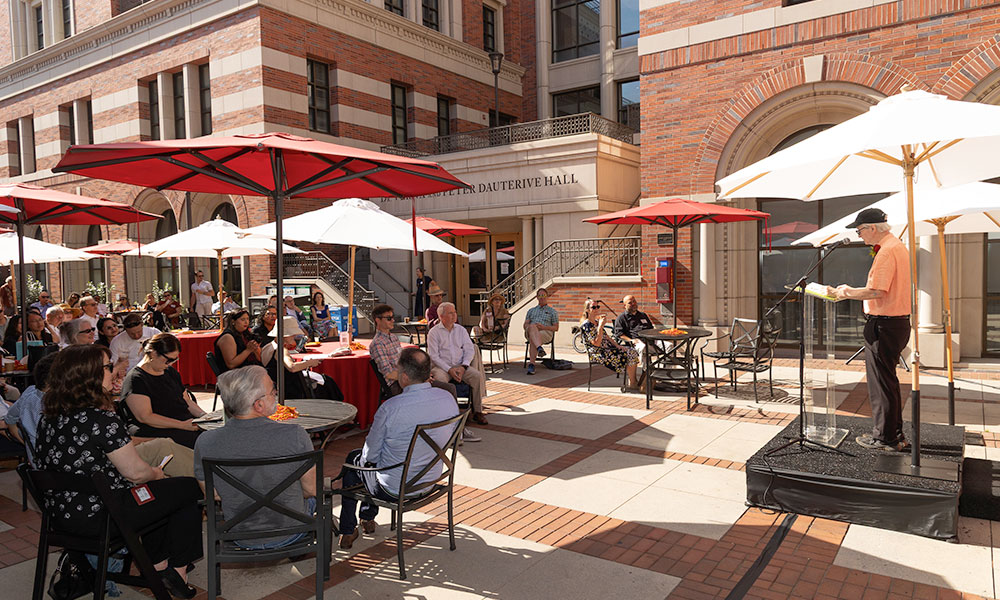
Sloane – who taught courses in history, urban planning, policy and more – shared his unusual career arc at a recent event celebrating his retirement and those of three longtime colleagues in the USC Price School of Public Policy’s Department of Urban Planning and Spatial Analysis: Genevieve Giuliano, Dowell Myers and Eric Heikkila. Together, the four professors helped expand the boundaries of urban planning while educating generations of students who now influence cities around the world.

The celebration posed a challenge for the authors and longtime academics: “What does one say about over four decades of a career in 20 minutes?” asked Giuliano.
Her solution was fitting for a scholar: She turned the question into a research project, collecting resumes from 22 of her former PhD students to explore how one’s legacy may be passed on through the current and future work of those one educates. She found that the field’s enduring concerns — accessibility, mobility and transportation policy — have taken on new forms as students pose fresh questions and apply new methods. For example, research that once examined the physical distance separating inner city workers from suburban jobs now considers inequalities in access to the virtual world, such as online food deliveries.
“My takeaway, from what really is a quick and dirty analysis here, is that legacy is real. Our work does continue through our students,” Giuliano said. “They innovate. They discover new questions, and by doing so, they deepen our understanding of the basic concepts of our field.”
Giuliano was appointed Distinguished Professor of Public Policy in 2023 and directed the METRANS Transportation Consortium for more than two decades. She also served as the USC Price School’s Interim Dean
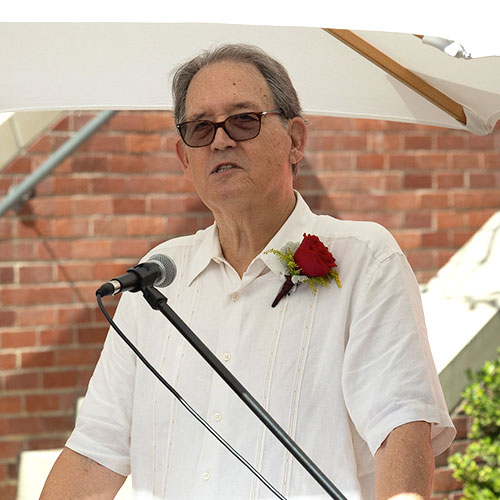
Myers, a specialist in urban growth and societal change, used his remarks to trace the emergence of housing demography, a field he helped establish by connecting two bodies of information that researchers had traditionally treated separately: population and housing data. Demographers tended to focus on people, he explained, while geographers studied housing, even though the census offered an opportunity to analyze the two together.
That seemingly simple connection opened a new line of inquiry into how people and communities change over time, including a topic that is especially relevant today: immigration. His research measured immigrants’ economic assimilation, rising homeownership and movement out of overcrowded housing.
“I wrote the book on how to connect population and housing,” Myers said. “The book was quickly sold out – or even better, either sold out or stolen.”
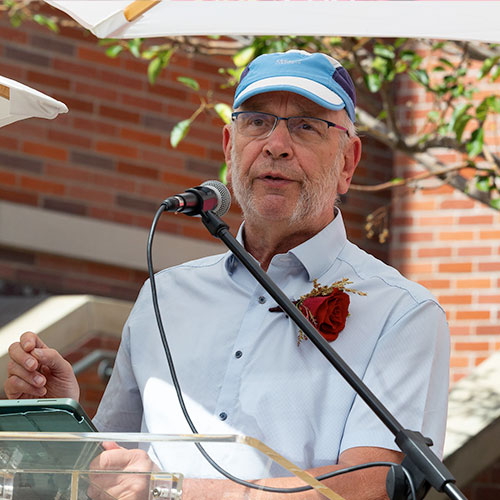
Heikkla’s research took him all over the world during the course of his 40-year career at the USC Price School. He spent sabbatical leaves in Taiwan and China, became founding Executive Secretary of the Pacific Rim Council on Urban Development, and did consulting work for the World Bank, United Nations and other organizations. In 2020, he wrote the book China from a U.S. Policy Perspective. He directed the Price School’s Global Engagement Office, too.
“I have an overwhelming sense of gratitude for the rare privilege of living a life of the mind, with self-directed learning as its enduring centerpiece,” Heikkla said. “Doing so in the company of such extraordinary colleagues has made it all the finer. Thank you, thank you, thank you.”
See more photos from the event at the USC Price School’s Flickr page.


