Nixon and Lincoln. Clinton and Carter. John Quincy Adams and George Washington.
What are the common themes of presidential leadership from the nation’s founding 250 years ago to today?
That was the focus of the 2026 USC Sol Price Leadership Lecture, part of the George Washington Leadership Lecture Series, now in its 14th year.
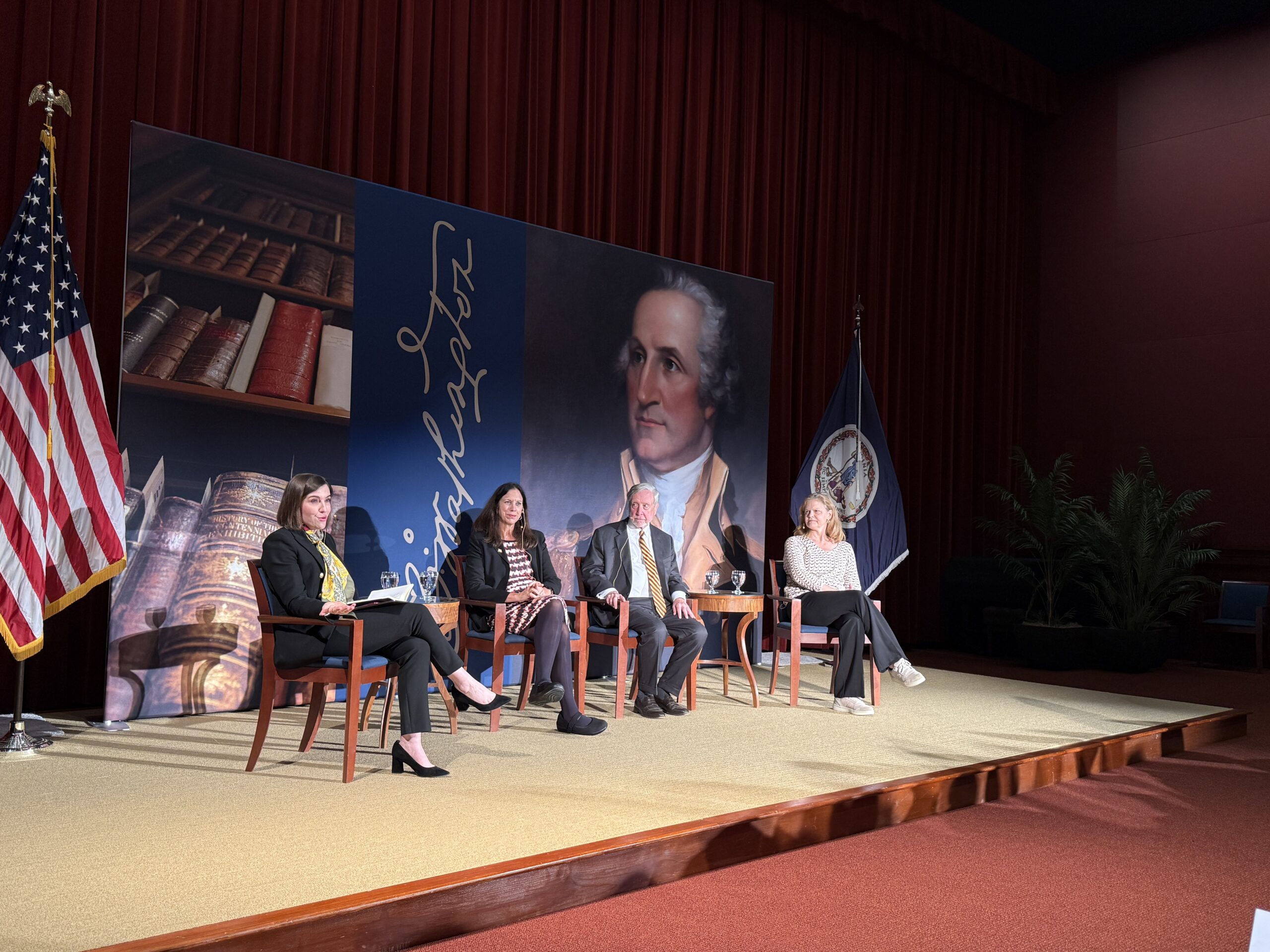
Switching twice a year between USC and Washington, D.C., the latest in the lecture series was held Oct. 6 at Mount Vernon to celebrate the publication of In Pursuit, a collection of essays, including several written by former presidents, about presidents and first ladies. The book was edited by former archivist of the U.S., Colleen Shogan, one of a group of panelists who discussed the book.
She was joined by award-winning historians Sean Wilentz and Beverly Gage in an hour-long discussion moderated by presidential historian Lindsay Chervinsky, executive director of the George Washington Presidential Library at Mount Vernon.
Humility and George Washington
Wilentz, the George Henry Davis 1886 professor of American History at Princeton University, noted that Washington, “was an incredible president because he constructed something out of the Constitution that didn’t exist. He helped oversee the creation of the American government … he laid the groundwork for things that everybody else could take for granted.”
Humility, said Wilentz, was a core Washington attribute.
“Maybe humility can be seen as a weakness,” Wilentz said. “But it’s not a weakness at all. It’s actually a strength, and one of his greatest acts was his renunciation of a third term during which he very well would have died, but nevertheless he renounced that because he did not want to set an example of a quasi-monarchical United States. He was very clear about that.”
Noted Chervinsky: “It was a very intentional demonstration that the office was bigger than one person, and I think that for the most part, presidents have really understood that. Their care for the nation in those moments is recognition that the office is bigger than them … That’s one of the most important throughlines in American history.”
Common themes
In Pursuit is a collection of 1,250-word essays about all U.S. presidents and select first ladies timed to this year’s July 4th celebration marking the semi-quincentennial of the signing of the Declaration of Independence.
Among the authors are three former presidents – George W. Bush (who wrote about George Washington), Barack Obama (Abraham Lincoln), Bill Clinton (Theodore Roosevelt) and three first ladies, Hillary Rodham Clinton (Eleanor Roosevelt), Michelle Obama (Jacqueline Kennedy), and Laura Bush (Lady Bird Johnson).
Shogan wrote about Grace Coolidge, Wilentz wrote about Clinton, and Gage penned an essay about Nixon.
Chervinsky wrote about John Quincy Adams.
Shogan, the first woman to lead the National Archives and Records Administration who now is senior advisor at More Perfect, an American alliance to engage institutions and citizens in protecting and renewing American democracy, pointed out common themes that emerge from In Pursuit.
One is the role that personal character and individual virtues play in presidential decision-making.
“Character matters when the chips are down,” Shogan said. “Character doesn’t matter on everyday stuff. It’s when the days are hard that character actually matters.”
The virtue of courage and role of “empathy guided by principle” plays out in several essays, Shogan said.
She elaborated: “Sometimes what is just and morally right can be at odds with what is politically advantageous. The larger theme is how we determine what we do, what is the decision between what is sometimes what is right and sometimes what politics demands of us or what is necessary.”
Distilling Nixon’s essence
Gage, the John Lewis Gaddis Professor of History at Yale University, said it was difficult to distill Nixon’s entire story down to a central theme.
She settled on his political style of being obsessed with his enemies – perceived or otherwise.
“You see that in him as a very young congressman — he already thinks everyone’s against him,” Gage said.
She added: “That sense of being embattled, I think, and of being under criticism, of being really quite obsessed with the people who are critiquing him — particularly liberals, particularly the press, particularly what he framed as the establishment — shapes his entire presidency, which allows him in some ways to develop a new political style of being very combative. And I think that resonates in our own political life.”
Bill and Jimmy
Wilentz noted that both Jimmy Carter and Bill Clinton came to D.C. as political outsiders.
But Clinton, unlike Carter, emerged as the “comeback kid” after his moving speeches following the Oklahoma City bombing on April 19, 1995, about two years and three months into his first term as president, Wilentz said.
“That was a moment where he was being tested — where the country was being tested actually — and you know, there are some people who fall to occasions,” he said. “Clinton rose to the occasion. And he did so in a way that I think actually brought people of very, very different views together … It was the beginning of his comeback to become reelected in 1996, which is an extraordinary thing.”
The annual George Washington Leadership Lecture Series at Mount Vernon is sponsored by the USC Sol Price School of Public Policy and the Fred W. Smith National Library for the Study of George Washington.
The lecture series was established through a gift by Maribeth Borthwick (’73), vice regent for California of the Mount Vernon Ladies’ Association, the non-profit that preserves and maintains the Mount Vernon estate originally owned by Washington’s family.
“I really do value this partnership a great deal,” said Christopher Boone, dean and C. Erwin and Ione L. Piper Chair of the USC Price School of Public Policy. “It really brings together some extraordinary and smart individuals to talk about issues that matter.
“The mission of the Price School is to improve quality of life for people in the communities here and abroad … and improving quality of life starts with the very founding of this country and of course with the words and the wisdom and the activities of our first president, George Washington.”