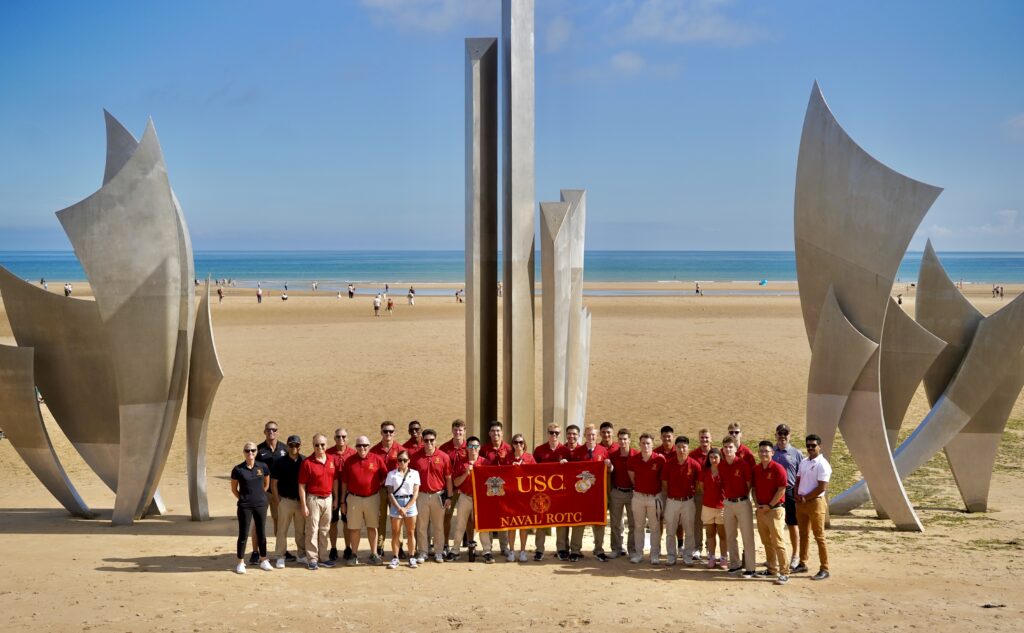
Eighty-one years after Allied soldiers stormed the beaches of Normandy, France, 20 Naval ROTC (NROTC) midshipmen recently trod the same ground to soak up the lessons from history’s largest seaborne invasion. The USC students were there not just to visit some of the world’s most famous battle sites, but to conduct research about the invasion as well as specific fallen soldiers.
“It was not just studying amphibious operations or joint warfare. I wanted them to deepen their understanding of our legacy and what that legacy means for all of our sailors and Marines who came before them,” said U.S. Marine Corps Capt. Mallory Vanderschans, who planned and co-led the experiential learning trip.
The trip, dubbed the Battle Study in Normandy and Belleau Wood, began at Normandy, where the group visited the Allied landing sites, the nearby American cemetery, and the surrounding cities that experienced heavy fighting during the invasion. It then moved to the Aisne-Marne American Cemetery and the Belleau Wood Battle Trail, the site of a historic World War I battle in Northeastern France, before winding up in Paris.
NROTC midshipmen and faculty pose on Omaha Beach in front of the “Les Braves” memorial sculpture named “The Wings of Hope,” “Rise, Freedom!” and “The Wings of Fraternity,” designed by French artist Anilore Banon.Midshipman Pierre Briand delivers a reflection at the Normandy American Cemetery, presenting research on fallen service members buried at the site, including those who remain unidentified. “You read dates on the headstones and see that people were the same age, even younger than you,” he said in a follow-up interview. “Driving through Normandy, it’s obviously peaceful today, a beautiful countryside. And then you come to the cemetery, and there’s rows upon rows of headstones that you can’t even fathom. It’s extremely sobering.”
The course was the first in what promises to be an annual trip. Another battle study at Pearl Harbor is already in its third year. “There is no better way to learn than being present,” said Price Professor and Director of ROTC programs, Frank Zerunyan, a strong supporter of experiential learning.
The Price School of Public Policy is the academic home of the USC ROTC programs, which include Naval, Army and Air Force ROTC units.
The trip took place between Aug. 12 and 18 and was made possible by a generous endowment from a USC NROTC alumnus. It was co-led by Vanderschans, U.S. Marine Corps Col. Tracy Perry, Executive Officer U.S. Navy Commander Josh Ragadio, and U.S. Navy Lt. Krishna Peri.
Normandy American Cemetery and Memorial in Colleville-sur-Mer was established by the U.S. First Army on June 8, 1944, as the first American cemetery on European soil in World War II. The cemetery contains more than 9,000 graves of fallen soldiers, many of whom lost their lives in the D-Day landings.From left to right, Midshipman Ian Williams, Normandy American Cemetery Superintendent Bob Adams, and Midshipman-Marine Option Rebecca Wyman fold an American flag that the group had the rare honor of hoisting at the burial grounds. This flag is now displayed at USC. Midshipmen toured abandoned bunkers atop the bluffs of Normandy from where German soldiers fired a withering barrage of cannon and machine-gun fire at the Allied soldiers. “At a human level, one feels sad and anxious in that bunker. Young men on both sides of the fire died following orders,” said Zerunyan, who envisioned the trip five years ago but was prevented from implementing the program due to the pandemic.
After Normandy, the midshipmen visited Caen and Sainte-Mère-Église, one of the first French towns liberated on D-Day by the Allies including the legendary Easy Company from the 101st Airborne Division. Their heroic exploits were depicted in the book and miniseries, Band of Brothers.
In Sainte-Marie-du-Mont, the midshipmen visited the home of Timothy Davis, President and CEO of The Greatest Generations Foundation. The residence, once a German headquarters in the Utah Beach sector, now includes a gallery of photographs honoring the many D-Day veterans who have returned to Normandy through the foundation’s programs.Davis’s house still displays murals of German soldiers.
The second portion of the trip took place in Belleau Wood near Marne, France, the site of one of the fiercest battles of World War I.
U.S. Marine Corps Col. Tracy Perry, Commanding Officer of the NROTC Unit Los Angeles, lays a wreath honoring the U.S., French, and German soldiers at The Marine Monument war memorial in Belleau Wood commemorating an unknown soldier known as Iron Mike.In a time-honored tradition for Marines, the midshipmen drank from the Devil Dog Fountain in the village of Belleau, a ritual tied to the Corps’ legacy in World War I. Midshipman (Marine Option) Rebecca Wyman made sure the “Devil Dog” now carries Trojan pride as an honorary member of the battalion.Midshipmen stand at the edge of the wheat field at Belleau Wood, where U.S. Marines charged across open ground under withering German machine-gun fire in June 1918. Against overwhelming odds, the Marines broke through and seized the enemy positions. “It’s just so powerful. You’re walking in these guys’ footsteps,” said Midshipman Third Class Alex Baret, who researched Belleau Wood for the trip. “To think of being under machine gun fire and the bravery that these guys had to get up out of a trench at a whistle blow. It was so moving to me, just to touch the ground. It was just incredible.”What trip to France would be complete without visits to see the Mona Lisa at the Louvre (left) and the newly refurbished Cathedral of Notre Dame? “It’s all well and good that they’re being trained to become fine officers, but there is room for them to learn about culture,” Zerunyan said.