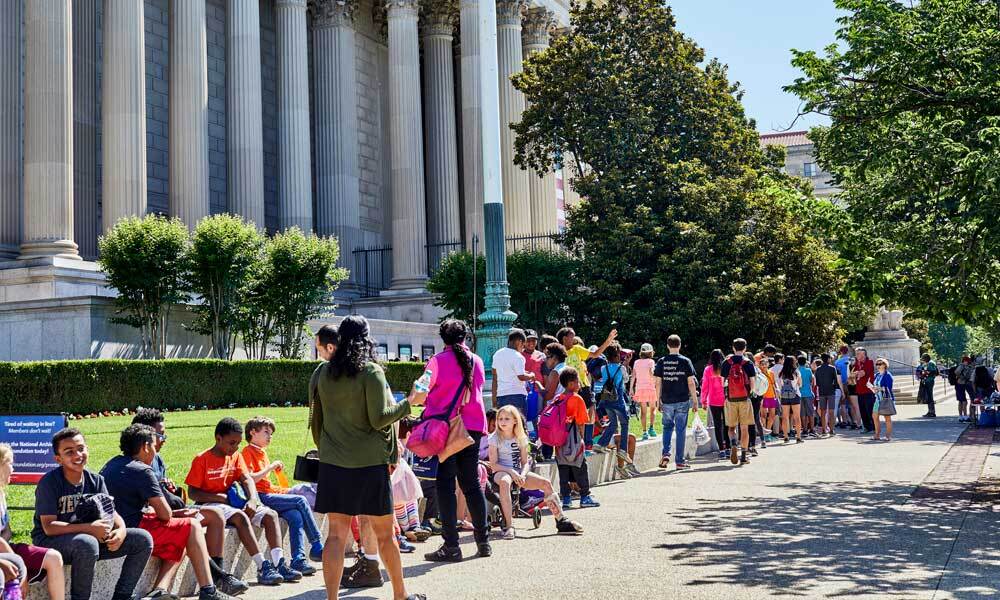
Less educated and lower income neighborhoods are consistently farther away from cultural institutions – such as elite universities, museums, and theaters – that can help advance one’s social mobility, according to a new study from the USC Price School of Public Policy.
What they researched: The study – published in the Journal of Economic Geography – is the first to quantify the geographic barriers that may reduce the number of lower-income and less educated households who consume the types of “cultural capital,” such as knowledge, skills and education, that enables greater social mobility.
- To conduct the analysis, Professor Elizabeth Currid-Halkett and former USC Price PhD student Andrew Eisenlohr measured both the straight-line distances and expected travel times between randomly sampled neighborhoods and eight amenities of cultural capital: libraries, museums, elite universities, Whole Foods stores, Equinox gyms and spas, fine performing arts venues, independent film venues, and art galleries within the 12 most populous American metropolitan areas.
Master of Urban Planning
Make Cities More Just, Livable & Sustainable
USC’s MUP degree trains students to improve the quality of life for urban residents and their communities worldwide.
Find Out MoreWhat they found: Communities with high levels of education are systematically closer to all eight representative sources of cultural capital, compared to their counterpart communities, which was true for measurements of straight-line distances and expected travel times.
- In addition, the highest income earning tracts are, on average, significantly closer to all forms of cultural capital than the lowest earning tracts, when distances are measured by expected travel times.
Why it matters: “We’ve increasingly realized that our cultural capital can dictate future outcomes,” Currid-Halkett said. “If it’s one of the attributes that explains social mobility, then isn’t the simple policy solution to provide more access? Well, then you start to look at where cultural capital shows up in a place, and you realize it’s really physically and spatially out of reach for less educated and less well-off residents.”
- Seemingly small differences in distances between neighborhoods and cultural institutions may represent a significant geographic hurdle, the study noted. Previous research has shown how households are less likely to use public transit rail stations that are more than half a mile away or enroll children in schools that are further away, the researchers pointed out.
- That means that even “free” cultural capital, such as libraries or museums, is seemingly out of reach.
What can policymakers do? The study authors made several recommendations to close these access gaps, including:
- Diversify access to elite universities, whose neighborhoods are often home to museums, libraries and performing arts venues as well.
- Redistribute affordable housing across neighborhoods, which could improve less-educated and lower-income households’ levels of access to cultural institutions.
- Introduce children and young adults to cultural capital directly. Elementary and secondary schools should instruct students on the importance of accruing cultural capital, particularly its role in promoting social mobility.
Go deeper: Currid-Halkett is the author of the book The Sum of Small Things: A Theory of the Aspirational Class, which uses the concept of cultural capital to explore how today’s elites deepen class divides.