
With free speech facing challenges from seemingly all points on the political spectrum, it was no surprise that the hot-button issue took center stage at the latest installment in the George Washington Leadership Lecture Series.
The lively discussion featured Rikki Schlott, a free-speech activist, New York Post columnist and co-author of The Canceling of the American Mind, and Ian Rosenberg, a media lawyer specializing in First Amendment, libel and intellectual property law, an adjunct associate professor at Brooklyn College, and the author of The Fight for Free Speech: Ten Cases That Define Our First Amendment Freedoms.
Switching twice a year between USC and the George Washington Presidential Library at Mount Vernon in Washington, D.C., the latest in the lecture series, now in its 13th year, was held March 24 at Town and Gown.
Both Maribeth Borthwick, whose gift established the lecture series, and moderator Jeffery A. Jenkins, Provost Professor of Public Policy, Political Science, and Law and the Maria B. Crutcher Professor of Citizenship and Democratic Values, quoted Washington in their opening remarks.
“Washington was no stranger to tonight’s topic,” Borthwick told the audience. “He believed in free speech. In fact, one of his most famous speeches was a passionate one he gave to his officers in 1783 to dissuade them from rebelling. His support of free expression was clear and unequivocal:
“‘If men are to be precluded from offering their sentiments on a matter,’ Washington said, ‘the freedom of speech may be taken away, and dumb and silent we may be led like sheep to the slaughter.’”
Jenkins said Washington’s words “resonate with even greater urgency today.”
A real danger
Schlott and Rosenberg agreed that the greatest threat to free expression is the government.
“I think that we are really in danger right now of losing our rights,” Rosenberg said. “The most important thing we can do is to be aware of [our First Amendment rights] and therefore hopefully be able to defend them.”
But the threat is not limited to our own government.
Pointing the finger at social media, Schott said our societal understanding and exercise of free speech values is “consistently degrading.”
She added: “A lot of people are not even fully aware of the free-speech values that make being an American such a profound blessing … I think we’ve not yet entered a period where we know how to use social media and use this more robust discourse in a productive way … Our social connections are being torn apart by the fact that we don’t have healthy discourse and we don’t have a healthy way to situate ourselves in this new media ecosystem.”
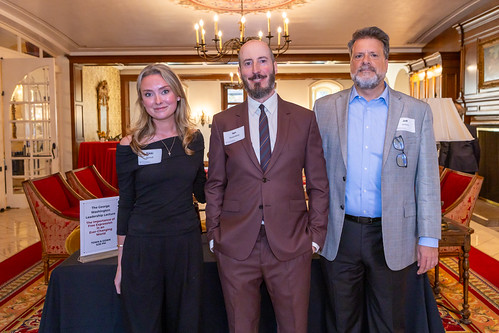
Rosenberg said attacks on the media are the “first wave” of attacks against our free expression rights as individuals.
“Yes, the president, no matter what president you’re talking about, has always had a difficult and tough relationship with the media,” he noted. “Yes, there has always been an effort to diminish the media so that presidents can talk directly to the American people without moderation or without critique.
“But I think that people are beginning to ask how is this different [this time] and what are my rights in connection with these efforts to curtail expression?”
Harmful speech
Jenkins asked the panelists how a speaker’s right to dissent should be balanced with the public’s right to hold the speaker responsible for the harm his or her words may cause.
“Freedom of speech does not mean freedom from consequences,” Rosenberg said. “But too often, I think we’re letting the term ‘cancel culture’ be used for anything that someone doesn’t like when they say something that is unpopular.”
Schlott agreed.
“Cancel culture as a term is sometimes cringeworthy the way that it’s been dragged through the mud,” she said. “Oftentimes, people who are not able to back up their points or respond to or retort are misusing free expression and hiding behind the veil of cancel culture.”
Rosenberg noted that the government must have viewpoint neutrality.
“That’s one of the core principles of First Amendment law, that the government can’t prefer one idea over another. And, in fact, the government can’t even regulate false speech.”
Jenkins asked the two panelists if it’s possible for a university to be both a safe space and a place for dangerous ideas.
“I think it really depends on how you define a safe space, and unfortunately everyone defines it in a different way, which I think is part of what the problem is,” Schlott said. “A lot of students will say that they feel unsafe in the presence of viewpoints that just differ from them, which is obviously not a healthy thing.
“However, I would say that most schools have decent and robust protections in their student handbook against overt harassment. I think the lines are well drawn.
“I think that what universities can do and what in my opinion they’ve failed to do in recent times is orient young people who have not been given a civic education in high school on the values of free speech when they arrive on campus and teach them what safety really means, which is not being protected from ideas that make you uncomfortable. That’s the whole point of being [at a university].”
Rosenberg elaborated: “Of course, we should have robust First Amendment protections both in the world and in the country and on campus for what Justice Oliver Wendell Holmes called ‘freedom for the thought we hate.’
“One reason why we should protect the thought we hate today is because the thought we hate today may become the truth of tomorrow. I think too often protest culture in history takes on a rosy glow of inevitability.
“But if you look at, for example, Gallup polls at the time of Dr. Martin Luther King’s march on Washington, most Americans at that time opposed both Dr. King’s message and the march.
“So, dissent is always or almost always unpopular. And I think that we cannot eliminate what is considered outrageous or difficult or even objectively hateful speech out of the idea that some things are just too strong for the protection of the First Amendment.”
USC’s commitment
Christopher Boone, Dean of the USC Price School of Public Policy and C. Erwin and Ione L. Piper Chair, noted at the event that USC is dedicated to promoting academic freedom and free speech.
He cited USC President Beong-Soo Kim’s initiation last October of the Open Dialogue Project, whose mission is to foster a campus culture where Trojans embrace and embody the principles of academic freedom, free expression, and open discourse. The project co-presented this year’s leadership lecture.
“I can think of no better place to do this,” Boone said, “especially for people in their formative years. [Universities] not only give them an opportunity to listen to others who they do not agree with, but to develop some understanding of why they might hold the viewpoints that they do – maybe not necessarily to agree or to fully compromise, but at least to understand that there are different ways of thinking and knowing about the world.
“This is the place where that should happen. And the Open Dialogue Project, I believe, is a fantastic example of dedication to those principles.”
The semi-annual George Washington Leadership Lecture is a bi-coastal series hosted by the USC Sol Price School of Public Policy and the George Washington Presidential Library.
The lecture series was established through a gift by Maribeth Borthwick (’73), Vice Regent for California of the Mount Vernon Ladies’ Association, the non-profit that preserves and maintains the Mount Vernon estate originally owned by Washington’s family.


