Panelists from both parties agree on reforms to primaries that could make Congress more functional
The USC Schwarzenegger Institute and the Unite America Institute recently hosted a two-day conference that explored reforms to primary elections. The event included discussions with academics, elected officials and political operatives from across the political spectrum.
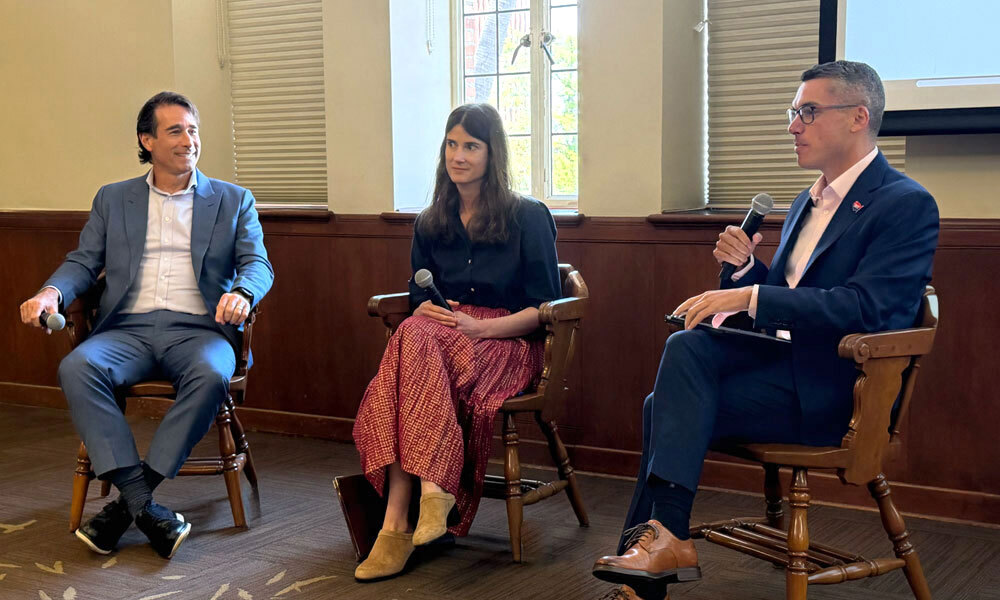
The keynote presentation featured Garret Graves, a Republican from Louisiana who served in the House of Representatives from 2015 to 2025, and Marie Gluesenkamp Perez, a Democrat who represents Washington state’s 3rd District. The discussion was moderated by Nick Troiano, Executive Director of Unite America Institute. The Schwarzenegger Institute for State and Global Policy is a research center affiliated with the USC Price School of Public Policy.
Despite being members of opposing parties, Gluesenkamp Perez and Graves found a good deal of common ground on how to improve election primaries – a key, they said, to restoring the credibility and effectiveness of Congress. They also agreed that Congress is badly in need of repair.
“Any independent thought in Congress is condemned,” said Graves, who serves as a Fellow at the USC Dornsife Center for the Political Future. “I think that Congress’s functionality is declining, and so this is all trending toward more of a monarchy style of government, which I think is dangerous.”
Added Gluesenkamp Perez: “The congressional approval rate right now is at 9%, and so there are a lot of people who are like … we don’t care. Do something that’s useful for us.”
The panelists said the age of social media and online celebrity is having a corrosive effect on Congress, with certain members spending too much time posting and appearing on TMZ instead of legislating.
“I think that the reason TMZ is on the Hill now is because rather than knowing their constituents or being part of their communities, people are turning themselves into celebrities, into reality TV show, which is a poor substitute for actually knowing where you’re from and representing it with fidelity,” Gluesenkamp Perez said.
Graves said the least effective members of Congress are the ones who preen for the cameras, whereas the members you don’t hear about are the ones who are trying to get things done.
“There actually are some good people who are there for the right reasons, who really believe in doing what’s right and what’s best for America,” Graves said. “… a lot of people talk about term limits and let me be clear: There are a few people that I think after about two or three weeks should be term limited. But there are other people … and they’ve done amazing things representing their state.”
The speakers identified several factors supported by USC and UAI research that are undermining the effectiveness of Congress:
- Closed primaries, in which Republicans and Democrats can only vote for candidates from their own parties. This shuts out Independent and unaffiliated voters from voting in these primaries, which gives more ideologically extreme voters greater say in who runs in the general election.
- Centralized power among party leaders, which stems in part from closed primaries;
- The fear of losing a primary if a member works with the opposing party to pass legislation.
“… it’s the party leaders (who) control so much more power,” Graves said. “These same people have an extraordinary amount of power controlling billions of dollars in campaign cash and controlling whether a bill that is important for the community actually goes through.”
Graves and Gluesenkamp Perez agreed that open primaries, in which voters can choose candidates from either party, would help solve the problem.
“If you allow people to exercise independent thought and have open primaries, then you decentralize power,” Graves said. “You’re taking power away from that party leadership because they can’t use the closed primary system as a way to keep you in line.”
Gluesenkamp Perez has made this a signature issue, co-leading the Let America Vote Act with Democratic and Republican lawmakers, which, among other provisions, would allow unaffiliated voters to vote in primary elections.
According to Ballotpedia: “As of February 2026, 14 states require open primaries, 13 require closed primaries, 10 require semi-closed primaries, five require top-two style primaries, and in 11 states parties have discretion to choose participation rules for their primaries.”
The degree to which of closed vs. open primaries help or hinder Congress may be debatable, but Graves and Gluesenkamp Perez reiterated throughout their discussion that Congress is badly in need of repair.
“The number of times in literally hundreds of conversations with Republicans and Democrats in Congress that said, ‘I cannot vote for this,’ or ‘I can’t vote against it because if I do, I’m going to get primaried on the left or on the right.’” he said. “And the number of times that conversation was prefaced with, “I know what you’re asking me to do is the right thing.’ Think about that for just a minute. So here we have distorted outcomes, distorted votes because of the fear that they’re going to be primaried on the left or the right because of a vote that they take.”
It’s no wonder, then, that an increasing number of voters are opting to register as independents.
“People are fleeing both parties,” Gluesenkamp Perez said, “… and so the remainder, the people at your democratic county party, it gets smaller and more extreme and less representative.”


