
Choosing between urban design vs. urban planning can feel overwhelming if you’re not clear on how the fields differ in scope, scale, and daily work. Both fields shape cities, neighborhoods, and communities, but they do so in different ways.
Gaining clarity on the difference between urban design and urban planning and how the educational path to each compares will help you decide which career aligns with your interests, strengths, and long-term career goals.
What is urban design?
Urban design focuses on shaping the physical form and character of cities, towns, and neighborhoods. At its core, urban design is about the human experience of cities, particularly the design of the public realm and how buildings relate to shared spaces.

An urban designer works in the space between architecture and planning. They don’t design individual buildings in detail (that’s the architect’s job), nor do they primarily create policy and zoning frameworks (that’s the urban planner’s job). Rather, they focus on how buildings, streets, and public spaces fit together spatially and visually.
Urban designers ask questions like:
- Is this street comfortable to walk along?
- Do buildings create a sense of enclosure or openness?
- Are there places for people to gather?
- Does the area feel safe and welcoming?
- Is the space intuitive and easy to navigate?
The goal is to create places that function well socially, economically, and environmentally, but also feel good to be in.
Urban design overlaps with architecture, landscape architecture, and planning, but it’s distinct in its focus on how the physical pieces of a city work together.
Examples of urban design projects include:
- Revitalizing a downtown district
- Designing a waterfront development
- Planning a mixed-use neighborhood
- Improving streetscapes with trees, lighting and sidewalks
- Creating a public space or civic plaza
Urban design shapes what people see and experience every day.
What is urban planning?
Urban planning focuses on how land is used, how infrastructure is organized, and how communities grow in efficient, equitable, and sustainable ways.
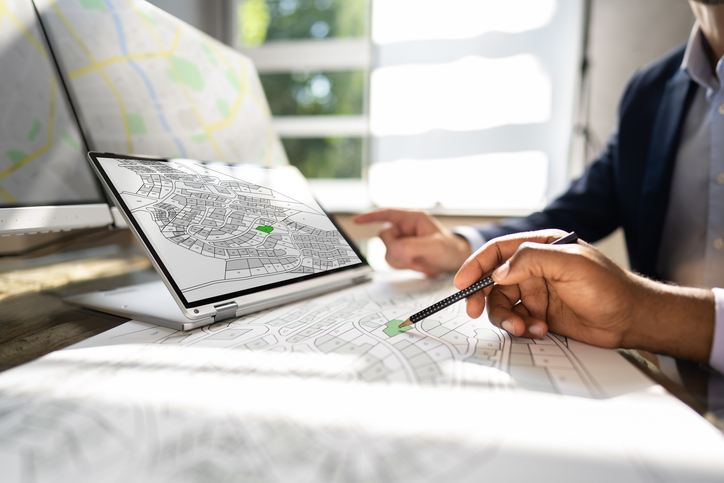
Planners coordinate the systems that allow cities to function. Their work typically happens at the neighborhood, citywide, or regional scale. Rather than designing buildings, planners create regulatory frameworks that determine what can be built and where.
Urban planners ask questions like:
- Where should future housing be located?
- How can traffic congestion be reduced?
- How can we prepare for climate change?
- How do we prevent urban sprawl?
- How can we increase housing affordability?
The answers to these questions are translated into official community plans, zoning laws, and regulations.
Urban planning is closely tied to government public policy. Many planners work for city or regional governments, consulting firms, or nonprofit organizations. A major part of planning involves working with community members, elected officials, and other stakeholders to balance competing interests and ensure transparency in decision-making.
Urban planners propose the rules, policies, and long-term vision that guide development, helping communities create places that are livable, sustainable, and resilient.

How to choose between an urban design degree vs urban planning degree
How do you like to work?
Urban design is about shaping the physical form. An urban design degree is a great choice for students who think visually and spatially, enjoy creative pursuits like drawing and sketching, and care deeply about how places look and feel. If you often imagine how a neighborhood could be redesigned, or you’re drawn to visual problem solving, this may be the path for you.
Urban planning focuses on shaping policies and systems. An urban planning degree is a great choice for students who think analytically and strategically, enjoy analyzing data, research, and policy, care about systems over aesthetics, and want to influence regulations and public decisions. If you’re more interested in how cities function rather than how they look, planning may be a better fit.
What kind of impact do you want to make?
Once built, the impact of an urban designer’s work tends to be more visible and immediate. The impact is often noticeable as soon as a project is complete. If a street becomes more walkable because of better design, people feel it immediately.
The impact of urban planning is more broad and systemic. Planning decisions are extremely important to how people experience a city, but the impact of those decisions may unfold slowly over many years. For example, transit-oriented development policy might take 15 years to fully reshape a corridor. Planning decisions are often long-term frameworks that guide gradual change.
Urban design shapes the emotional and physical experience of a place, while urban planning shapes the opportunity, equity, and long-term growth patterns. Both are powerful, but operate at different levels of visibility and impact.
What to expect from an urban design degree
Urban design degrees are typically studio-based and housed in architecture or design schools. Standalone undergraduate degrees in urban design are less common than planning or architecture degrees, but they do exist.

More often, students interested in urban design at the undergraduate level study:
- Architecture
- Landscape Architecture
- Environmental Design
- Urban Studies
- Urban Planning
Students who plan on pursuing an advanced degree in urban design may benefit from a foundation in urban planning due to the collaborative nature of the two fields.
A Master of Urban Design (MUD or MA/MS in Urban Design) is the most common urban design degree. Admission often requires a portfolio and prior design experience.
An urban design curriculum typically includes:
- Advanced urban design studios
- Public space design
- Urban theory
- 3D modeling and visualization
- Sustainability and resilience
Graduates often work as urban designers in architecture firms, design studios, or multidisciplinary consultancies.
What to expect from an urban planning degree

An urban planning degree focuses on policy, systems, and long-term development strategy, preparing students to manage land use, infrastructure, housing, transportation, environmental regulation, and public policy at community, city, or regional scale. The degree’s emphasis is on decision-making frameworks.
Students at the undergraduate level interested in planning usually pursue a degree like USC Price’s Bachelor’s of Science in Urban Studies and Planning (BSUSP).
Undergraduate degrees in urban planning prepare students in:
- Analytical techniques for urban sustainability
- Methods for stakeholder engagement
- Practical programming skills
- Communication with diverse communities
- Land use planning
- Transportation systems
- Urban economics
- Housing and community development
- Urban history and theory
- Geographic Information Systems (GIS)
A master’s degree in urban planning builds on this foundational knowledge and trains students for career advancement. Curriculum focus shifts from understanding systems to designing and managing them.
Urban planning master’s students gain deeper expertise in:
- Advanced land use law
- Transportation modeling
- Housing policy analysis
- Climate adaptation planning
- Infrastructure finance
- Economic development strategy
- Equity and social justice frameworks
- Quantitative research methods
For example, students enrolled in USC Price’s Master’s of Urban Planning (MUP) program interested in design have the option of choosing the Design of the Built Environment concentration, which addresses the architecture of the city as a set of visual and functional connections between buildings, streets, and neighborhoods. Students in this concentration are encouraged to draw from courses related to landscape architecture and historic preservation in the USC School of Architecture.
USC Price’s MUP program offers six concentrations in:
- Arts & Culture
- Design of the Built Environment
- Economic Development
- Planning for Climate Change & Sustainability
- Housing & Real Estate Development
- Mobility & Transportation Planning
Urban planners and designers interested in academia, research, or high-level advisory careers may go on to pursue a doctorate. Ph.D.s in urban design and planning are more interdisciplinary and connect to related fields. For example, the Ph.D. in Urban Planning and Development (UPD) program at USC Price focuses on developing expertise in fields such as:
- Climate change and sustainability
- Data science and spatial analysis
- Real estate
- Urban design
- Land use
- Demography
- Arts, culture, and community development
- Planning theory and social justice
- Transportation and mobility
A doctorate provides students with a strong foundation in critical discourse paired with analytical and theoretical training to develop skills necessary to launch a scholarly career.
Alumni Spotlight

USC alum Manarbek Toleu, who earned a Master of Urban Planning (MUP) at USC Price with a certificate in real estate development in 2023, is an architectural designer for Walt Disney Imagineering, the creative team behind the immersive experiences at Disneyland in Anaheim, California. Toleu develops master plans and architectural drawings for the theme park, working on projects ranging from a monorail station cafe to a 50-foot sculpture of a princess castle, commemorating the park’s 70th anniversary.
“Disneyland is very iconic and a cherished place,” Toleu said. “I always wanted to see how the magic attractions and hotels and all these experiences get created, and I had no idea that someday I might actually get to participate in the projects.”
Toleu is a double Trojan, having earned his bachelor’s degree at the USC School of Architecture before studying at the USC Price School. After seeing so many projects fail due to a lack of socioeconomic research – such as a government-funded metro line that flopped – Toleu took an interest in urban planning. As an MUP student, he learned how data analytics can provide the foundation for major projects by answering important questions upfront, such as the demand for a project or potential economic benefits.
The USC Price certificate in real estate development also combined architecture with finance skills, teaching him all that it takes to build a building.
“Learning that expanded my understanding of architectural design and urban planning,” Toleu said.
Where urban design and urban planning overlap
It’s important to understand that planning and design are not opposites. Many professionals like Manarbek blend multiple fields by:
- Studying planning and specializing in urban design
- Studying architecture and later moving into urban design
- Focusing on physical planning within a planning career
- Earning dual degrees
When considering urban design vs. urban planning, sometimes the answer is both. The fields are complimentary, not oppositional.
Planners focus on things like setting density targets and affordability requirements, while designers shape the physical environment that meets those goals attractively. Each discipline informs the other: policy can guide design, and design insights can lead to regulatory change.


