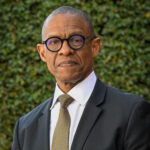
Leaving medical school and moving across the country to become a dog catcher isn’t the expected start to a career for someone who ended up becoming a professor at one of the nation’s top universities – oh, and a former undercover FBI agent.
When Erroll Southers was pondering a follow-up to his first book, “Homegrown Violent Extremism” (2013), literary agents and publishing companies had two words for him:
Forget it.
“I was going to write another book on terrorism,” says Southers, who is also a USC Sol Price School of Public Policy Professor of Practice in National and Homeland Security.
“Everyone told me, ‘No, Erroll. We want the story of your life.’”
So, four years ago, Southers began writing his second book while sitting beside a pool in Costa Rica where he and his wife, Caryn, purchased a second home a few years ago.
In the company of iguanas and howler and white-face capuchin monkeys, Southers produced a memoir, Inside the Castle Walls: An American Journey Through Espionage, Counterterrorism and Government, released in March by Gouché Publishing House. Hollywood executives are now interested in adapting the book into a film or television show.
Spy games
The cover of the 472-page book, co-authored by Justin Hienz, features a striking portrait of Southers looking every bit the serious, lean-machine, former champion bodybuilder he is – a person who appears to be full of gripping tales of espionage that would sate the most ardent fans of fictional tough-guy operatives Jack Ryan and Jason Bourne.
Arnold Schwarzenegger, one of Southers’ best friends whom the future professor met in 1981 while training at World Gym in Santa Monica, wrote the forward.
“‘Come on, Erroll,’” Southers recalls his famous buddy saying after he asked the legendary bodybuilder, actor and former governor of California to pen the book’s opening. “Who else can write the forward for you?”
Inside the Castle Walls relives, in mostly chronological order, Southers’ life, from being stopped by police officers as a youngster in the mid-1960s in his small hometown in N.J. (for “walking while Black,” he writes) to positions in law enforcement and national security at the local, state, and federal levels, both public and private.
The book is based on meticulous journals Southers compiled over the years and details exciting adventures he enjoyed at every stage of his career – some of them classified and dangerous.
“I want people to believe we still live in a country where almost anything is possible.”
Erroll Southers
For example, in the chapter titled “Mr. Saunders” (Southers’ alias on one case while working as an undercover agent in the agency’s San Diego field office), he chronicles his attempt to “flip” a KGB-controlled intelligence officer posing as a visiting scientist to the United States. (“Flipping” means recruiting a foreign spy to work for U.S. agents to collect sensitive information in their homeland.)
Pretending to be a spoiled rich kid working in a research lab, Southers befriended “Marko,” a Russian spy. They spent a lot of time driving around San Diego and L.A. in “Mr. Saunders’” chocolate-brown Maserati, supplied by the FBI.
At one point, Marko became suspicious of Southers and patted him down while sitting beside him in the Maserati to ensure he wasn’t carrying a weapon. Inches away from Marko, locked in the glove box, is Saunders’ 9mm Sig Sauer pistol.
“Well,” a satisfied Marko told Saunders, “It’s not like you would be a spy.”
The FBI Prepublication Review Office vetted Southers’ memoir, which uses aliases for the real people he encountered and worked with while an undercover agent.
“I’m surprised the FBI didn’t redact more from the book,” says Southers, who at 69 is in the gym pumping iron before 5 a.m. and is a Peloton junkie.
‘Anything is possible’
Southers’ memoir also describes his current post at USC, where he oversees more than 300 employees in the departments of public safety, fire safety and emergency planning, and environmental health and safety. Southers earned two graduate degrees from the USC Price School of Public Policy: a Master of Public Administration (MPA) in 1998 and a Doctor of Policy, Planning and Development (DPPD) in 2013.
“Only in this country could this happen,” Southers says of his life of public service and a conviction to lead change from inside the castle walls. “It happened because of my parents, my education, and because in this country, it’s possible, and I want people to be inspired by it. I want people to believe we still live in a country where almost anything is possible.
“I also want people to understand my life has largely been in public service, and I put a great deal of emphasis on that. I want people to serve their city, their state, and their country.”
“I hope that middle-school students read this book as well as people my age so they can be inspired to say, ‘This can happen to me, too.’”
The title of Southers’ memoir – its themes include race, power, patriotism, loyalty, and education – comes from something his father, James, told him after he was profiled numerous times by the police and complained about it:
You can’t change the castle from outside the moat.
Career climbing
Southers’ career in law enforcement started in 1980 at the Santa Monica Police Department (he took the dog catcher job because he needed to pay rent).
“Talk about humbling,” writes Southers. “I was an Ivy League (Brown University in Rhode Island) graduate who, until that time, was on a fast track to a prestigious future in medicine (as an orthopedic surgeon), and there I was chasing stray dogs in a Santa Monica Animal Control Department pickup truck. It had portable kennels in the rear. Dressed in a khaki short-sleeved shirt and green trousers, it felt like being on a safari at times.”
Southers says he left medical school because “when I got there, I realized that wasn’t what I wanted to do.”
Two years after joining the Santa Monica PD, Southers became a drill instructor at the Rio Hondo Police Academy.
Two years after that, he was in the FBI academy in Quantico, Va. He spent four years in the bureau – a job Schwarzenegger encouraged him to take.
“Arnold has an incredible way of assessing opportunities, and he approached everything from a business perspective,” writes Southers. “He (said), ‘Erroll, if you go to the FBI, even if you are there for a few years, you will have career prospects you have never even thought about.’”
As governor of California, Schwarzenegger appointed Southers deputy director for critical infrastructure protection at the California Office of Homeland Security, a post he served from 2004 to 2006. In 2007, Southers began a four-year stint as chief of the Los Angeles World Airports police department’s Office of Homeland Security and Intelligence, the nation’s largest aviation law enforcement agency.
In September 2009, Southers was President Barack Obama’s first nominee for assistant secretary of the Transportation Security Administration, but he withdrew. Southers also served for 11 years as head of security and assistant vice president for the Los Angeles County Museum of Art and is a past president of the Los Angeles Board of Police Commissioners.
Interest from Hollywood
Southers has taught two homeland security courses at the USC Price School and remains on the school’s faculty.
“For me, teaching was a joy,” he writes. “What I liked most was the diversity of students I had the opportunity to meet. There was a real appetite for a homeland security course, and I attracted students from several academic disciplines, including engineering, business, law, and social work.
“There were students interested in counterterrorism policy, in how people radicalize to extremism, in the complex coordination between government agencies and in the implications for civil liberties.”
Southers notes in his memoir that nothing in the book was created with the assistance of AI or ChatGPT. Southers is a plaintiff in Anthropic’s recent $1.5-billion settlement stemming from a class-action lawsuit from authors and publishers for using copyrighted books to train its Claude AI model. A final ruling is pending but the settlement has been preliminarily approved.
A few weeks ago, Southers’ memoir was optioned by Hollywood Ventures Group, a global entertainment company launched by former Amazon MGM Studios executive Glenn Gainor and producer Sandy Climan, to develop the book for film and/or television.
Could this be the start of a new Jack Ryan-esque franchise?
That’s classified.